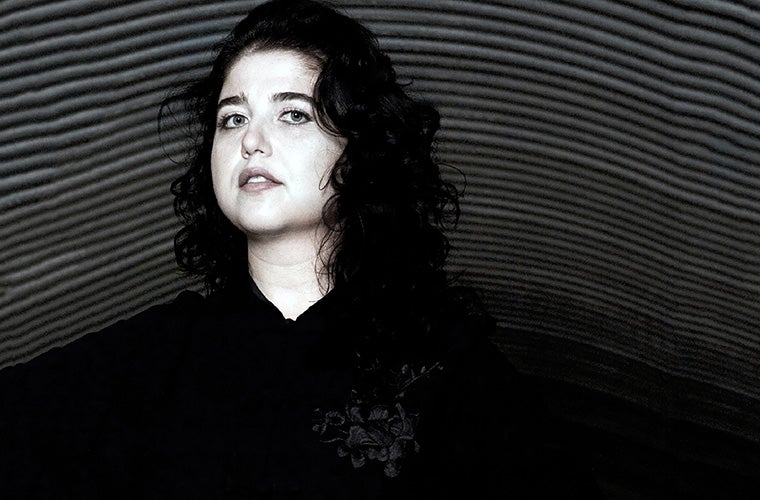
Lera Auerbach


Lera Auerbach (b. 1973, Russia/Austria/USA)

Lera Auerbach is a composer, pianist, and writer whose music combines intense emotion with brilliant craft. Born in Chelyabinsk, a city in the Ural Mountains or Russia and now based in the U.S., she started composing at a young age and quickly gained recognition for her expressive, dramatic, and highly pianistic works.

Her works can be virtuosic, but they are always deeply expressive, exploring both inner reflection and theatrical drama.

Lera Auerbach’s Twenty-Four Preludes for Piano (Op. 41), composed in 1999, spans all major and minor keys, creating a full tonal journey from C major to D minor. Commissioned by Tom and Vivian Waldeck in collaboration with the Caramoor International Music Festival, Auerbach premiered the cycle herself in New York on July 23, 1999. A typical performance lasts about 39 minutes, making it substantial yet accessible for recitals. Each prelude has its own character, ranging from short bursts of energy to reflective, lyrical moments. The cycle alternates between major and minor keys requiring careful attention to clarity, mood shifts, and tonal exploration. 


Chorale, Fugue, and Postlude (2003)- This work blends old forms with her modern voice. The chorale is a clash of sounds, both "forceful" and meditative at the asame time, while the fugue is more precise and energetic, and the postlude balances both with elements of each. Here is her Chorale: 


Auerbach’s piano music challenges and rewards.  Her works are perfect for recitals that want drama, depth, and expressive storytelling with music that connects immediately with both performer and listener.


Comments

Popular posts from this blog

Sofia Gubaidulina

Sofia Gubaidulina (1931- 2025) is one of the most fascinating and uncompromising composers of our time. Born in Tatarstan, she studied at the Moscow Conservatory and was often criticized by Soviet authorities for being too “irresponsible” in her search for new sounds. Dmitri Shostakovich, however, told her to continue on her “mistaken path”—encouraging her to stay true to her vision. And she did. Her music is often described as spiritual, mystical, and deeply symbolic. For Gubaidulina, composition is not just about notes on the page—it’s a form of searching for truth. She often uses contrasts (silence vs. sound, light vs. darkness, tension vs. release) to create works that feel both philosophical and intensely emotional. For us pianists, her output is small but powerful. Her early Chaconne (1962) is one of her most frequently performed works. It’s built on a repeating bass line, but don’t expect a Baroque-style chaconne—this one grows into something dramatic, dissonant, and modern, ...

Nazife Güran

Avniye Nazife Aral Güran (1921–1993) was a powerhouse of creativity, yet her name is still far too little known outside of Turkey. Born in Vienna to a Turkish diplomat father, Güran’s life was truly international. She studied in Istanbul, Berlin, Cologne, and Ankara, blending European classical traditions with the cultural richness of her homeland. Güran composed over 1,000 works across nearly every genre: piano music, lieder, orchestral scores, children’s songs, marches, and dramatic ballades. Her output shows a composer who was tireless, imaginative, and determined to bring Turkish culture into dialogue with Western forms. Three Concert Études (1979) showcase her modernist side—virtuosic, structured, and demanding.  At the same time, shorter pieces such as Kennedy Nocturne , İlkbahar (“Spring”), and Boğaziçinde İkebana reveal her gift for intimacy and atmosphere. These miniatures sparkle with character and are perfect for pianists looking to bring something new and meaningf...

Vítězslava Kaprálová

Vítězslava Kaprálová (1915–1940) was a rising star whose life was tragically cut short at the age of 25, but in that short span left behind a body of music that glows with individuality, confidence, and daring. Born in Brno, Czech Republic, she was both a composer and a conductor, trained by masters like Bohuslav Martinů and quickly recognized as one of the most promising talents of her generation. Kaprálová’s music combines lyrical intensity with striking harmonic colors. She had a gift for weaving Czech folk influences into modern textures, creating music that feels deeply personal yet connected to her cultural roots. Beyond her compositions, she made history as one of the few women of her era to step onto the conductor’s podium, leading orchestras in Prague and Paris. Her piano works shimmer with vitality. Pieces like the Dubnová preludia (April Preludes), Op. 13 reveal her fresh harmonic language, lyrical expressiveness, and rhythmic bite. These preludes are concise yet packed ...